A Kingdom on the Brink
In 1177, the Kingdom of Jerusalem faced a moment of extreme vulnerability. Its ruler, Baldwin IV of Jerusalem, was just sixteen years old and already weakened by leprosy. At the same time, Saladin had emerged as the dominant power in the region, having united Egypt and much of Syria under his rule.
With much of Jerusalem’s military strength committed elsewhere, the kingdom was left dangerously exposed. Recognising this opportunity, Saladin advanced north from Egypt with a large and confident army, expecting little resistance.
A Young King with an Unusual Burden
Baldwin had come to the throne in 1174 at only thirteen, following the death of his father. From the outset, his reign was shaped by instability and threat. The Crusader states were not peaceful kingdoms; they required constant defence, and their rulers were expected to lead from the front.
What set Baldwin apart was his illness. His condition had been identified in childhood by his tutor, William of Tyre, who noticed the early symptoms of leprosy. Over time, the disease would reduce his physical strength and mobility. Yet despite this, Baldwin remained determined to rule actively and fulfil the expectations placed upon a medieval king.
A Strategic Misstep Weakens Jerusalem
The arrival of Philip I of Flanders in 1177 initially seemed to offer Baldwin a valuable opportunity. With additional forces at his disposal, there was even discussion of launching an ambitious campaign against Egypt, the heart of Saladin’s power.
However, these plans never materialised. Instead, Philip chose to campaign in northern Syria alongside Raymond III of Tripoli. Baldwin supported this effort, sending a significant number of his troops to assist. While strategically understandable, this decision left Jerusalem under-defended at a critical moment.
Saladin Seizes the Initiative
Saladin wasted little time in exploiting this weakness. In November 1177, he marched toward the southern territories of the kingdom, moving swiftly and with confidence. Travelling light, he left behind heavy baggage to maintain speed and flexibility.
His forces advanced toward key locations such as Ascalon, encountering little organised resistance. At this stage, it appeared that the invasion would proceed unchallenged.
A Desperate Defensive Position
Baldwin, recovering from illness, gathered what forces he could, reportedly only a few hundred knights. He moved to Ascalon and issued an arrière-ban, summoning all able-bodied men to defend the kingdom. Even so, his army remained vastly outnumbered.
When Saladin approached, Baldwin briefly engaged before withdrawing into the city’s defences. Reinforcements attempting to reach him were intercepted, and many were captured. The balance of power seemed overwhelmingly in Saladin’s favour.
Overconfidence and Opportunity
Confident that Baldwin posed no real threat, Saladin made a crucial error. He divided his army into smaller detachments to raid the countryside. Villages were burned, and towns such as Ramla and Lydda suffered heavily.
This decision, while profitable in the short term, left his forces scattered and vulnerable. It also revealed a dangerous assumption—that Baldwin would remain behind the walls of Ascalon.
Baldwin Takes the Offensive
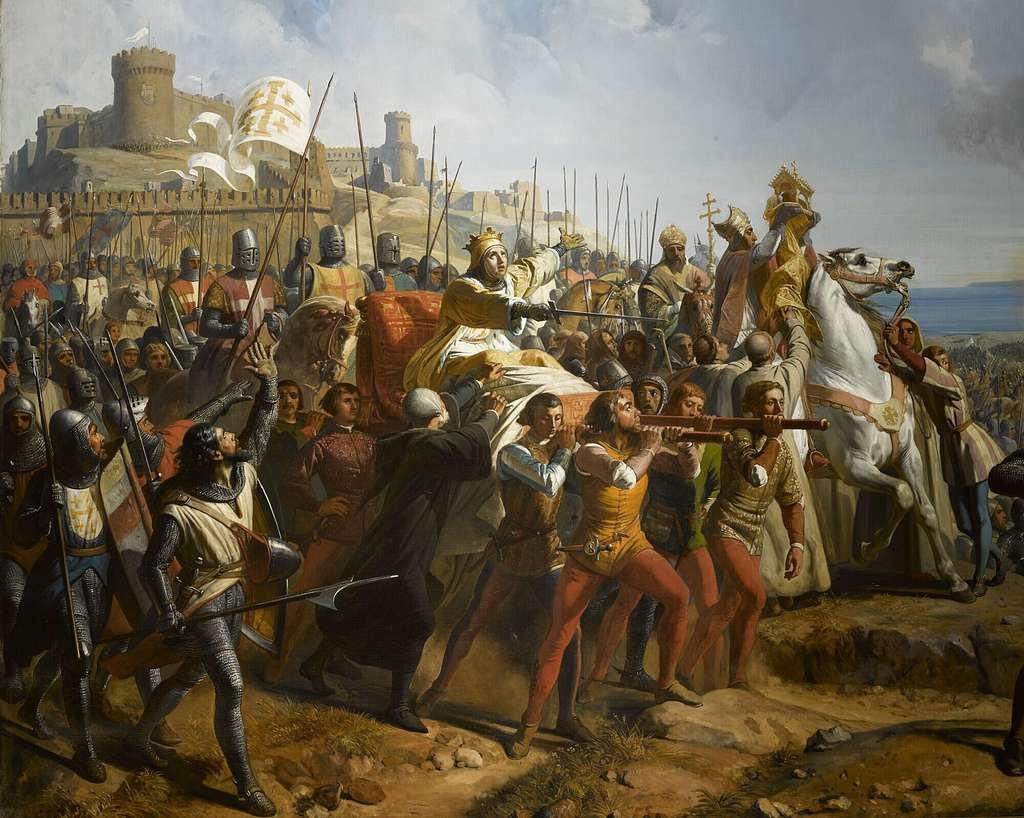
Baldwin refused to remain passive while his kingdom was devastated. Driven by duty and necessity, he made the bold decision to leave the safety of Ascalon. Slipping out without detection, he coordinated with nearby forces, including the Knights Templar, and prepared to strike.
This was a high-risk decision. His army was still significantly smaller than Saladin’s, and failure would likely have meant the destruction of what remained of Jerusalem’s military strength.
The Clash at Montgisard
On 25 November 1177, the two forces met near the Battle of Montgisard. Saladin’s troops were dispersed and unprepared, while Baldwin’s army was unified and ready for combat.
Before the attack, the True Cross was carried before the Crusader forces, reinforcing their belief that they fought with divine support. Baldwin, despite his illness, took command and prepared his men for battle.
The assault came as a surprise. Saladin’s forces struggled to regroup as Baldwin’s troops advanced. What began as a chaotic engagement quickly turned against the sultan as his lines broke under pressure.
The Collapse of Saladin’s Army
As the battle intensified, Saladin attempted to rally his troops, but the lack of cohesion proved decisive. His army began to retreat, and the withdrawal soon became a rout.
Many of his soldiers were cut down as they fled, while others were captured. Only his elite Mamluk guard maintained discipline, fighting fiercely to protect their leader and ensure his escape. Saladin ultimately fled the battlefield on a camel, his campaign in disarray.
A Victory Against the Odds
The scale of Baldwin’s success was extraordinary. Although exact numbers remain uncertain, it is clear that he faced a significantly larger force. His victory was the result of bold decision-making, effective use of surprise, and the determination of his troops.
At just sixteen years old, Baldwin had achieved a defining triumph. The battle established his reputation as a capable and courageous ruler, despite the limitations imposed by his illness.
Remembering Montgisard
In the aftermath, the wounded were cared for and returned to Jerusalem. Baldwin oversaw the distribution of spoils and marked the victory with celebration. To commemorate the event, he later ordered the construction of a monastery on the battlefield.
Despite the scale of the triumph, Baldwin understood that the conflict with Saladin was far from over. Further campaigns would follow, and the struggle for control of the region would continue.
Even so, Montgisard left a lasting impression. Decades later, during the Seventh Crusade, stories of the battle were still being told. The image of a young, afflicted king defeating a far stronger enemy ensured that the event remained one of the most celebrated victories of the Crusades.
Frequently Asked Questions
What was the Battle of Montgisard?
The Battle of Montgisard was a major clash in 1177 where a smaller army of the Crusader States led by Baldwin IV of Jerusalem defeated the much larger forces of Saladin.
How did Baldwin IV defeat Saladin?
Baldwin achieved victory through surprise, timing, and exploiting Saladin’s divided forces. Saladin had dispersed his army to raid the countryside, leaving them vulnerable to a sudden, concentrated attack.
How old was Baldwin IV at the Battle of Montgisard?
Baldwin IV was approximately sixteen years old when he fought at Montgisard, making his victory even more remarkable given his youth and illness.
Why was the Battle of Montgisard important?
The battle temporarily halted Saladin’s expansion and boosted morale within the Crusader States. It became one of the most celebrated victories of the Crusades.
How many troops fought at Montgisard?
Exact numbers are debated, but Baldwin likely commanded a much smaller force than Saladin, possibly outnumbered by several times over