The First Crusade did not emerge in a vacuum. When Pope Urban II called for a military expedition to the East in 1095, he was responding to decades, indeed centuries, of political, religious, and military developments.
To understand why the First Crusade was launched, we must first examine the situation in the East. From the rise of Islam to the collapse of Byzantine power in Asia Minor, the world beyond Western Europe was undergoing a profound transformation.
The Eastern Mediterranean in Late Antiquity
In late antiquity, power in the East was dominated by two great empires: the Roman (later Byzantine) Empire and the Persian Empire. Although the Western Roman Empire declined, its eastern half endured as the Byzantine Empire.
The rivalry between Byzantium and Persia defined the political landscape of the Middle East for centuries. This balance shifted dramatically under the Byzantine Emperor Heraclius, who succeeded in defeating the Persian Empire and reclaiming key territories, including Syria and the Holy Land.
Yet this victory proved short-lived. A new and powerful force was emerging: Islam.
As G. W. Bowersock has observed, Heraclius’ destruction of Persia left Byzantium exposed. With its great rival eliminated, the Byzantine Empire now stood alone against the rapid expansion of the early Islamic caliphates.
The Rise of Islam and the Loss of the Holy Land
The expansion of Islam in the seventh century was swift and transformative. Muslim armies absorbed the former Persian Empire and then advanced into Byzantine territories.
Key cities fell in rapid succession:
- Damascus in 634
- Antioch and Gaza soon after
- Jerusalem in 638
For Byzantium, the loss of Jerusalem was not only strategic but deeply symbolic. The city was central to Christian identity, and its fall marked a profound shift in the religious landscape of the region.
Further losses followed. In 641, Alexandria fell, depriving Byzantium of Egypt’s vital grain supply. Over time, North Africa was also lost.
Despite repeated attempts, Muslim forces failed to capture Constantinople. These failed sieges were crucial. Had the city fallen, Islamic expansion into Europe may have accelerated dramatically. Byzantium thus acted as a vital buffer between the Islamic world and Western Christendom.
Jerusalem Under Muslim Rule
After the Muslim conquest, Jerusalem remained a multi-religious city. Christians were permitted to practice their faith but were treated as second-class subjects under Islamic rule.
Their status was governed by the Pact of Umar, which imposed restrictions such as prohibiting the construction or repair of churches, limiting public expressions of faith, and enforcing social hierarchies between Muslims and non-Muslims.
Although these measures allowed for coexistence, they ensured Christian subordination. Over time, many churches fell into disrepair due to restrictions on maintenance and rebuilding.
Nevertheless, Jerusalem retained its spiritual importance for Western Christians. Pilgrimage continued throughout the early medieval period, and communication between Eastern and Western Christian communities persisted, even if political ties weakened.
The Destruction of the Church of the Holy Sepulchre (1009)
A dramatic moment came in 1009, when the Fatimid caliph Al-Hakim bi-Amr Allah ordered the destruction of the Church of the Holy Sepulchre, one of Christianity’s most sacred sites.
Al-Hakim, often remembered for erratic and extreme policies, also imposed harsh measures on Jews and Christians, including distinctive dress codes and restrictions on worship.
The destruction of the Holy Sepulchre shocked the Christian world, though historians debate the extent of its immediate impact in Western Europe. Some argue that it provoked little response at the time, particularly as the church was rebuilt by 1048. Others suggest that it contributed, at least indirectly, to growing concern about the fate of the Holy Land.
By the late eleventh century, however, the event had faded in urgency, especially since the site had been restored.
The Turning Point: The Battle of Manzikert (1071)
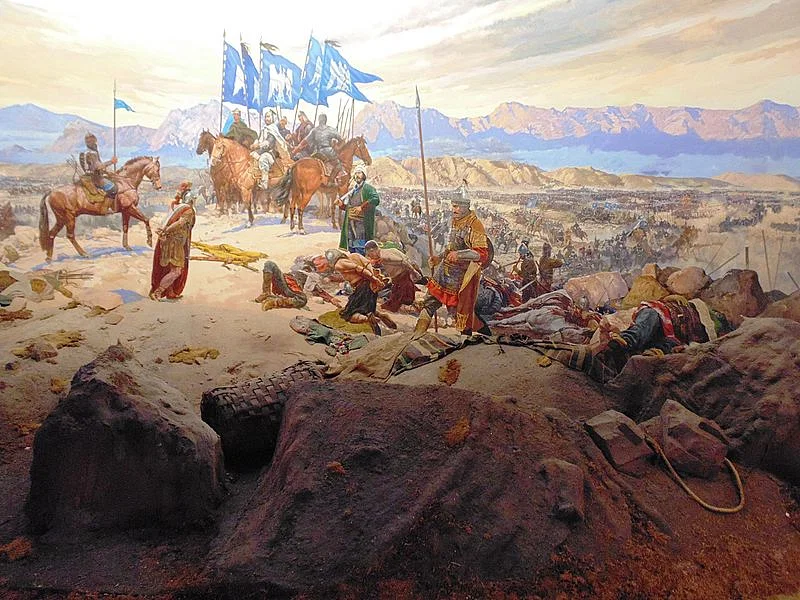
If one event fundamentally altered the balance of power in the East, it was the Battle of Manzikert.
In 1071, the Byzantine army, led by Emperor Romanos IV Diogenes, was decisively defeated by the Seljuk Turks under Alp Arslan.
The consequences were severe. Romanos was captured, humiliated, and ultimately removed from power. More importantly, Byzantine control over Asia Minor began to collapse.
This defeat did not immediately end the pilgrimage to Jerusalem, but conditions worsened over time. By the late eleventh century, the Seljuk Turks were increasingly restricting access to Christian pilgrims.
Even more damaging was the internal chaos that followed. The Byzantine Empire descended into civil war, weakening its ability to resist external threats. Neighbouring powers, including the Normans, exploited this instability.
Manzikert marked the beginning of a prolonged crisis for Byzantium and a key step toward the First Crusade.
Crisis in the East on the Eve of the Crusade
By the 1090s, the situation had deteriorated significantly. Byzantine territory in Asia Minor continued to fall to the Seljuk Turks, including key regions such as Cilicia and Tarsus.
The Byzantine Emperor Alexios I Komnenos attempted to stabilise the situation, even forming alliances with Muslim rulers such as Malik-Shah of Baghdad. However, Malik-Shah’s death in 1092 removed this crucial support.
Facing mounting losses and unable to halt Seljuk expansion, Alexios turned to the West. In 1095, he appealed to Pope Urban II for military assistance.
This request set in motion one of the most significant events of the medieval world.
Urban’s response, delivered at the Council of Clermont, called upon Western Christians to take up arms and aid the East. What followed was the First Crusade—a movement that would reshape relations between East and West for centuries.
Conclusion: A World in Crisis
On the eve of the First Crusade, the Eastern Mediterranean was a region in turmoil.
- The Byzantine Empire had lost vast territories and faced internal instability
- Islamic powers had expanded rapidly and controlled key Christian sites
- Pilgrimage routes had become increasingly dangerous
- Appeals for aid from Byzantium had reached Western Europe
The Crusade was not simply a religious movement; it was a response to a complex geopolitical crisis.
Understanding this context allows us to see the First Crusade not as an isolated event, but as the culmination of centuries of change, conflict, and shifting power in the medieval world.
For further exploration, see my post on the situation in the west on the eve of the First Crusade.

1 comment
[…] For further exploration, see my post on the situation in the East on the eve of the First Crusade. […]