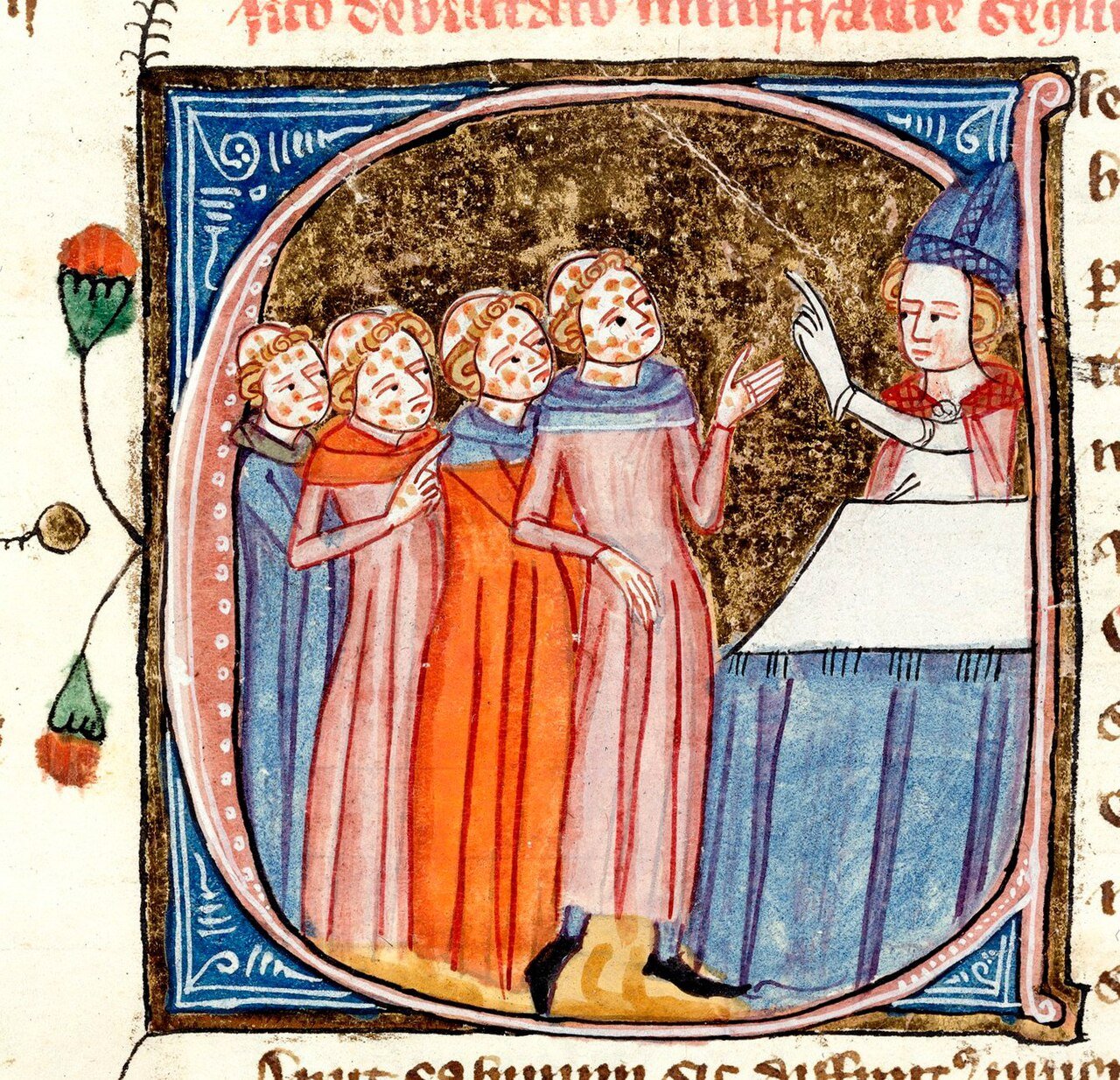
Few diseases inspired more fear in medieval Europe than leprosy. To modern readers, leprosy is understood as an infectious illness, but in the Middle Ages, it carried meanings far beyond the physical body. It was associated with sin, heresy, lust, divine punishment, spiritual purification, and even holiness. To become a leper was not simply to become ill, it was to acquire a powerful social and religious identity.
Leprosy occupied a complex position in medieval society. Lepers could be pitied, feared, excluded, or admired. They were treated as both dangerous outcasts and specially chosen sufferers whose pain might bring salvation. No disease better reveals the medieval tendency to interpret bodily illness through the lens of morality and religion.
Leprosy as a Mark of Sin
Medieval attitudes toward leprosy were shaped heavily by the Bible, especially the Old Testament. In Leviticus, those afflicted with skin disease were described as ‘unclean’ and separated from the community. Medieval writers inherited these ideas and often interpreted leprosy as visible proof of inner corruption. As Leviticus states, ‘All the days wherein the plague shall be in him he shall be defiled, he is unclean’.
The ninth-century scholar Rhabanus Maurus wrote, ‘Leprosy is the false doctrine of heretics… lepers are heretics blaspheming against Jesus Christ’. Maurus believed that sin caused imbalance within the body and that disease was the outward manifestation of inward corruption.
This connection between illness and morality endured for centuries. Even in the fifteenth century, Thomas Gascoigne claimed that King Henry IV of England was suddenly struck with ‘horrible leprosy of the worst sort’ after ordering the execution of Archbishop Richard Scrope. Although this diagnosis is doubtful, the story reveals how deeply leprosy remained associated with divine judgement.
John of Salisbury offered another biblical example in his account of King Uzziah from the Old Testament. Salisbury wrote that after Uzziah usurped priestly authority, leprosy immediately struck him. The lesson was clear, leprosy marked those who had offended God through pride and disobedience.
Heresy and Contamination
Leprosy was not only feared as an illness, but it was also used as a metaphor for dangerous ideas. Twelfth-century writers drew analogies between heresy and leprosy, describing false doctrine as something that spread through the limbs of Christendom like a disease.
Another common image was that heresy spread through poisoned breath, infecting those who came into contact with its carriers. In this worldview, spiritual contamination and physical contamination were closely connected. The leper became a symbol of disorder, someone whose condition threatened the wider Christian community.
As Moore has demonstrated, medieval writers frequently linked deviance, pollution, and exclusion. Lepers and heretics could both be imagined as dangers to the health of society.
Lust, Menstruation, and Sexual Sin
Leprosy was especially associated with sexual misconduct. Medieval medicine, drawing on classical ideas of bodily humours, linked health to balance and moderation. Sexual excess was thought to disturb that balance and invite disease.
St Jerome claimed that if a woman had intercourse during menstruation, the child conceived might become leprous. Albert Magnus likewise warned that a man who slept with a menstruating woman risked becoming a leper himself. Because the Church prohibited intercourse during this time, leprosy could be presented as punishment for sin.
Once afflicted, lepers were often portrayed as having heightened sexual desire. A thirteenth-century description of leprosy claimed many lepers ‘burn with desire for coitus… They gladly have intercourse with the healthy’.
Brody has argued that leprosy was especially associated with the sin of lechery. The disease became linked not simply to illness, but to lust, bodily excess, and moral weakness.
Radulphus Flaviacensis, commenting on Leviticus in the twelfth century, believed above all that leprosy symbolised those who had sinned and refused repentance. Disease therefore, became a visible sign of spiritual failure.
The “Living Dead”
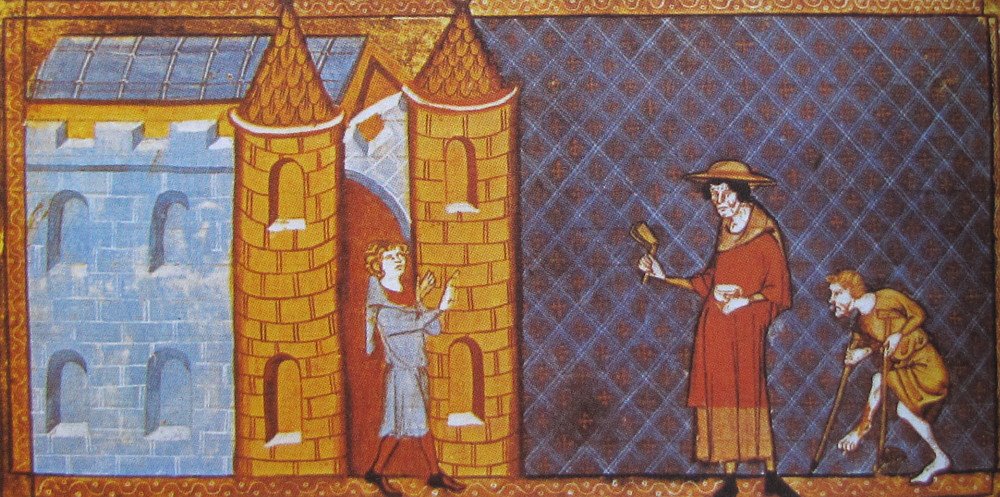
Perhaps the most striking aspect of medieval leprosy was the ritual of exclusion. Throughout the Middle Ages, legislation was enforced to separate lepers from wider society. The Third Lateran Council of 1179 reinforced segregation and recognised the distinct status of lepers.
Before formal exclusion, ceremonies sometimes took place which resembled funerals. A leper might kneel before an altar or, in some cases, stand in an open grave. Earth was thrown upon the leper’s head three times while the rules of separation were read aloud.
The leper could be forbidden from entering churches, monasteries, fairs, mills, marketplaces, or taverns. They were not to wash in streams or fountains, nor walk through narrow lanes. They were forbidden to touch children and could eat or drink only from their own dishes.
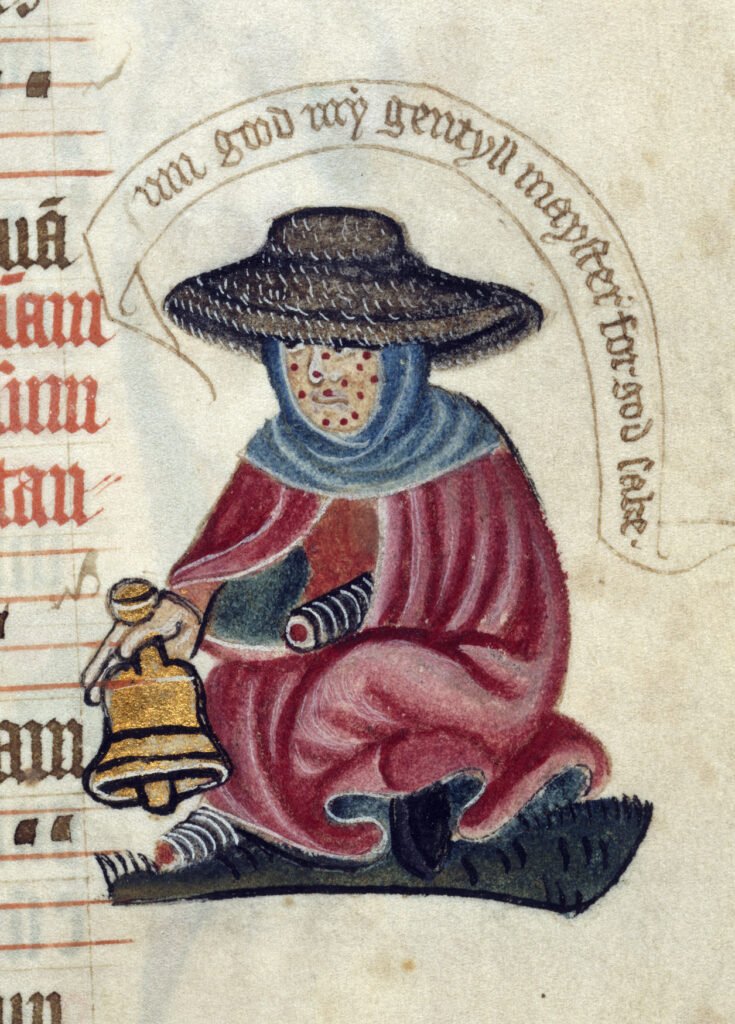
If spoken to on the road, the leper was to turn downwind before answering. Lepers were also required to wear distinctive clothing and carry a bell, clapper, or rattle to warn others of their approach.
Such rituals reflected the notion that lepers were the ‘living dead’. Though physically alive, they had been symbolically removed from ordinary society.
Loss of Rights and the Leprosarium
Segregation did not simply restrict movement; it could also diminish legal rights. In England, from Norman times, lepers were barred from inheritance, from making wills, and from pleading in court. Elsewhere, practice varied. In Hainault, for example, lepers could still dispose of property by will.
Many lepers were expected to live in isolation or within communities of fellow sufferers known as leprosaria. These institutions were governed by rules similar to those of religious houses. Residents often required permission to leave, sometimes only in pairs, and conversation between men and women could be forbidden.
Yet the leprosarium was not always purely punitive. It could also offer food, shelter, companionship, and organised care. In a world with limited medical knowledge, exclusion and protection were often closely intertwined.
The Holy Sufferer
Although lepers were often viewed as sinners, a parallel tradition regarded them as especially blessed. Some medieval Christians believed leprosy acted as a form of purgatory, allowing sufferers to pay for sins in this world rather than the next.
Jacques de Vitry in the thirteenth century stressed that disease could be welcomed as a blessing marking the path to spiritual perfection. Leper houses were sometimes situated near bridges or fords, symbolising the soul’s passage into heaven.
St Hugh of Lincoln wrote of lepers, ‘These… could confidently await the coming of our Saviour, Jesus Christ, who would transform their vile bodies into the glory of His risen body’.
This promise of redemption led some Christians to admire, or even envy, the leper. Ralph, the ‘ill tonsured’ monk of Marmoutier, is said to have prayed to be afflicted with leprosy in order to atone for his sins.
The Parable of Lazarus also reinforced this idea. Lazarus suffered in life but was carried by angels into heaven, while the rich man endured torment. Medieval audiences could easily associate the leper with Lazarus, rewarded after earthly misery.
Christ and Charity
Christianity also encouraged compassion toward lepers through the example of Christ, who repeatedly healed them in the Gospels. Medieval preachers often told stories of Jesus appearing in the form of a leper to test the faithful.
Gregory the Great recounted how a monk carried an exhausted leper upon his shoulders. When they reached the monastery gates, the leper revealed himself as Christ and ascended into heaven, promising a reward to the monk in the afterlife.
Stories such as this encouraged Christians to aid lepers despite fear of disease. To care for the leper could be to care for Christ himself.
What Medieval Leprosy Reveals
Leprosy mattered so deeply in the Middle Ages because it stood at the crossroads of medicine, religion, morality, and social order. Medieval people did not separate body and soul in the modern sense. Disease could be a physical condition, moral warning, divine punishment, and spiritual opportunity all at once.
To study medieval leprosy is therefore to study medieval fears, fear of sin, fear of contamination, fear of disorder, and fear of divine wrath. But it also reveals medieval hopes, redemption through suffering, charity toward the afflicted, and the belief that those rejected by society might be closest to God.
Leprosy was more than a disease. It was a mirror in which medieval Europe saw both its anxieties and its faith.
References
S.N. Brody, The Disease of the Soul. Leprosy in Medieval Literature, (New Yor, 1974).
R.I. Moore, The Formation of a Persecuting Society, Power and Deviance in Western Europe, 950-1250, (Oxford, 1987).
C. Rawcliffe, Leprosy in Medieval England, (Woodbridge, 2006).