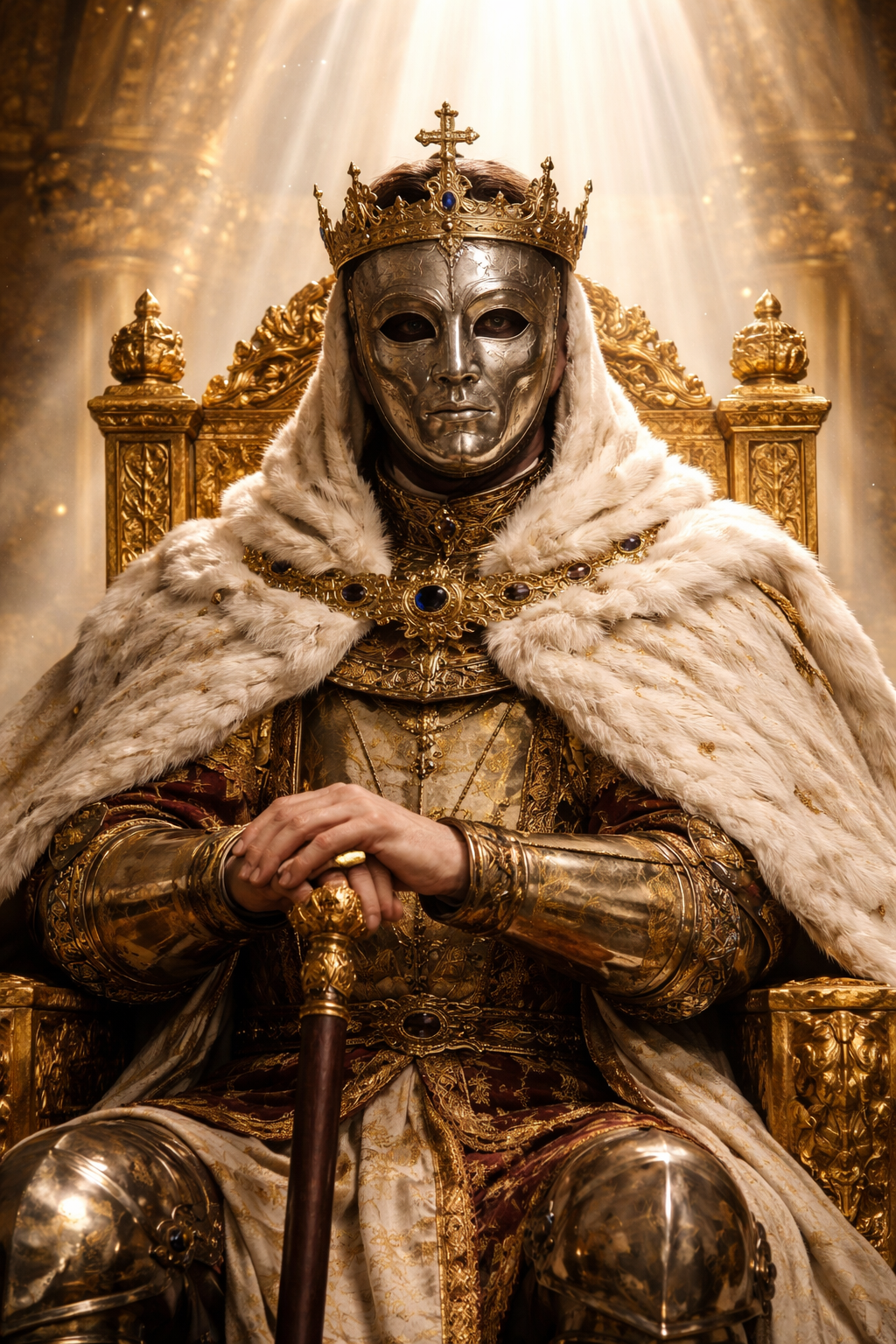
It was back in 2005 when Ridley Scott’s epic film Kingdom of Heaven was released. The big-budget production featured some of the finest actors of the time, with no expense spared on locations, costumes, and large-scale battle sequences. While the film as a whole received mixed reactions from historians, one aspect that was widely praised was Edward Norton’s portrayal of Baldwin IV of Jerusalem, better known as the Leper King.
Norton famously chose not to have his name appear in the opening credits, which added a layer of mystery to the character. This decision allowed audiences to focus entirely on Baldwin himself rather than the actor behind the mask. The result is one of the most memorable and haunting performances in the film. But how accurate is this portrayal when compared to historical reality?
The Mask
In the film, Baldwin wears a silver mask throughout almost the entirety of his appearances. The only time it is removed is after his death, when his sister Sibylla looks upon his face and is visibly distressed by the extent of his disfigurement. This moment is designed to emphasise both the physical toll of leprosy and the emotional weight carried by those around him.
Leprosy, now known as Hansen’s disease, affects the skin, nerves, and extremities. It can cause discolouration, lesions, and severe deformities over time. The depiction of Baldwin’s face in the film—pale, scarred, and damaged—is likely a reasonably accurate representation of advanced leprosy.
However, the question remains: did Baldwin actually wear a mask?
There is no historical evidence to suggest that Baldwin IV wore a mask during his lifetime. While it is possible he may have attempted to cover his face at times, no contemporary sources mention such a practice. The primary chronicler of Baldwin’s life, William of Tyre, provides a key insight. He writes that Baldwin’s followers were “moved with pity when they looked upon him,” which strongly suggests that his face was visible.
The mask, therefore, appears to be a cinematic invention. It serves both a practical purpose—concealing the actor—and a symbolic one, representing Baldwin’s isolation and the burden of his illness. While not historically accurate, it is an effective storytelling device.
Voice and Physical Condition
Leprosy does not only affect the skin; it can also impact nerves and, in some cases, the structures involved in speech. As the disease progresses, it can make speaking more difficult, particularly if facial muscles are affected.
The only contemporary description of Baldwin’s voice comes again from William of Tyre, who notes that “his speech was somewhat halting.” This brief comment suggests that Baldwin may have struggled with clear or fluid speech, particularly in the later stages of his illness.
In the film, Baldwin’s voice is calm, measured, and authoritative, though occasionally breathless. This may reflect an attempt to show his physical weakness while still maintaining his dignity and authority as a king. At times, however, he speaks with clarity and strength that may not entirely reflect his real condition.
That said, a fully realistic portrayal—featuring severely impaired speech—might have made the character less accessible or engaging for audiences. The film strikes a balance between realism and narrative clarity, offering a portrayal that feels believable without becoming distracting.
Defying the Odds: Baldwin IV’s Victory Over Saladin
One of the most striking elements of Baldwin’s story is his early military success. In the film, he recounts to Balian:
“When I was sixteen I won a great victory…”
This refers to the Battle of Montgisard, fought on 25 November 1177. The film incorrectly places the event in the summer, but the essence of the story is accurate.
At the time, Baldwin faced an invasion led by Saladin, one of the most formidable commanders of the medieval world. Saladin had already begun consolidating power across Egypt and Syria and posed a significant threat to the Crusader states. His forces vastly outnumbered those available to Baldwin.
Compounding the difficulty, much of the Crusader army had been sent north to support campaigns elsewhere, leaving Jerusalem vulnerable. Baldwin, only sixteen years old and already suffering from leprosy, was forced to act with limited resources. He gathered a small force of knights, including members of the Templar and Hospitaller orders, and marched to confront Saladin.
What followed was an extraordinary and unexpected victory. Baldwin’s forces caught Saladin off guard and routed his army, forcing him to retreat. The triumph was remarkable not only because of the disparity in numbers, but also because of Baldwin’s youth and physical condition.
The significance of this victory cannot be overstated. It temporarily halted Saladin’s advance and boosted morale within the Crusader states. Decades later, the battle was still remembered. During the Seventh Crusade in 1252, an elderly man reportedly told a crusader:
“I saw Baldwin of Jerusalem, who was a leper, defeating Saladin…”
This enduring memory highlights just how extraordinary the event was.
The Discovery of Leprosy
In Kingdom of Heaven, Baldwin attributes the discovery of his illness to Godfrey of Ibelin, a fictional character played by Liam Neeson. According to the film, Godfrey noticed that Baldwin felt no pain when injured and recognised this as a sign of leprosy.
In reality, Godfrey did not exist. Balian’s real father, Barisan of Ibelin, died before Baldwin was born. The discovery of Baldwin’s condition is instead credited to William of Tyre.
William provides a detailed and vivid account of the moment he first suspected something was wrong. He describes how Baldwin, while playing with other boys, did not react to pain when pinched or bitten. This unusual lack of sensation prompted further investigation, eventually leading to the diagnosis.
This story aligns closely with modern understanding of leprosy, which often causes nerve damage and loss of sensation. In fact, the historical account is arguably more compelling than the film’s version, as it captures the gradual and unsettling realisation that something was seriously wrong.
Transport and Mobility
The film also depicts Baldwin’s physical limitations, particularly in scenes involving travel and warfare. At one point, he rides out to confront Saladin near Kerak, demonstrating his determination to lead despite his condition.
Historically, Baldwin was indeed able to ride a horse for much of his life. Although one of his arms became unusable at an early age, he was trained to ride using his legs, allowing him to maintain control of the horse while wielding a weapon with his remaining functional arm.
This detail reflects both Baldwin’s resilience and the efforts made to ensure he could fulfil his duties as king. Leadership in the medieval world often required a visible presence on the battlefield, and Baldwin was determined to meet that expectation.
In the later years of his reign, however, his condition deteriorated significantly. He eventually became too weak to ride and was transported in a litter. The film accurately portrays this, showing him being carried as his strength declines.
This detail is historically grounded and reinforces the physical toll of his illness, while also highlighting his commitment to his role.
Baldwin’s Character and Leadership
In Kingdom of Heaven, Baldwin is portrayed as a wise, measured, and peace-seeking ruler. He is shown as someone who values diplomacy and seeks to avoid unnecessary conflict with Saladin.
This portrayal is partially accurate. Baldwin was respected by both his allies and his enemies, including Saladin himself. He demonstrated political skill and a willingness to pursue peace when it was advantageous.
However, the film arguably leans too far in presenting him as a pacifist. In reality, Baldwin was fully prepared to engage in warfare when necessary and did not hesitate to confront Saladin militarily. His reign included both diplomatic efforts and active military campaigns.
Baldwin’s relationships with other nobles were also more complex than depicted. His eventual successor, Guy of Lusignan, had a strained and often contentious relationship with him. Baldwin’s decision to support Guy’s marriage to his sister Sibylla was influenced by political concerns, including fears of rival claims to the throne.
Similarly, his relationship with Raymond III of Tripoli was far from harmonious. While the film presents Raymond (renamed Tiberias) as a loyal advisor, the historical reality was marked by tension and political manoeuvring. Raymond served as regent at times, but this was due more to his position than to personal trust.
These complexities are largely simplified in the film, likely to streamline the narrative and maintain focus on the central characters.
Conclusion
Kingdom of Heaven offers a compelling and memorable portrayal of Baldwin IV, the Leper King of Jerusalem. While the film takes several liberties—most notably the introduction of the mask and the simplification of political relationships—it captures the essence of Baldwin’s character and the challenges he faced.
Historically, Baldwin was a remarkable figure: a king who ruled effectively despite a debilitating illness, a commander who achieved victory against overwhelming odds, and a leader who navigated a fragile and divided kingdom. His reign represents a brief moment of stability before the eventual collapse of the Crusader states following his death.
The film succeeds in bringing this story to life, even if it sacrifices some accuracy for dramatic effect. In doing so, it ensures that Baldwin IV remains one of the most fascinating and enduring figures of the Crusader period.
FAQ: How Accurate Is Kingdom of Heaven?
How accurate is Kingdom of Heaven overall?
The film is partially accurate. It captures the setting of the Crusades and key figures like Baldwin IV of Jerusalem and Saladin, but simplifies events and relationships for dramatic storytelling.
Did Baldwin IV really wear a mask?
No. There is no historical evidence that Baldwin IV wore a mask. This was added in the film as a symbolic and visual device.
Was Baldwin IV’s leprosy portrayed accurately?
Partly. Baldwin did suffer from leprosy, but the film exaggerates its visible effects and presents his condition as more advanced throughout his life than sources suggest.
Did Baldwin IV defeat Saladin, as mentioned in the film?
Yes. Baldwin defeated Saladin at the Battle of Montgisard in 1177, although the film only briefly references this and gets some details wrong.
Is Baldwin’s voice and physical condition realistic in the film?
Somewhat. Historical accounts suggest his speech was affected, but the film presents him as more articulate for clarity and dramatic impact.
Are the political relationships in the film accurate?
No. Relationships with figures like Raymond III of Tripoli and Guy of Lusignan are simplified, and much of the real political tension is reduced.
Is Balian of Ibelin portrayed accurately?
No. Balian of Ibelin was a nobleman, not a blacksmith, and his role in events is heavily fictionalised.