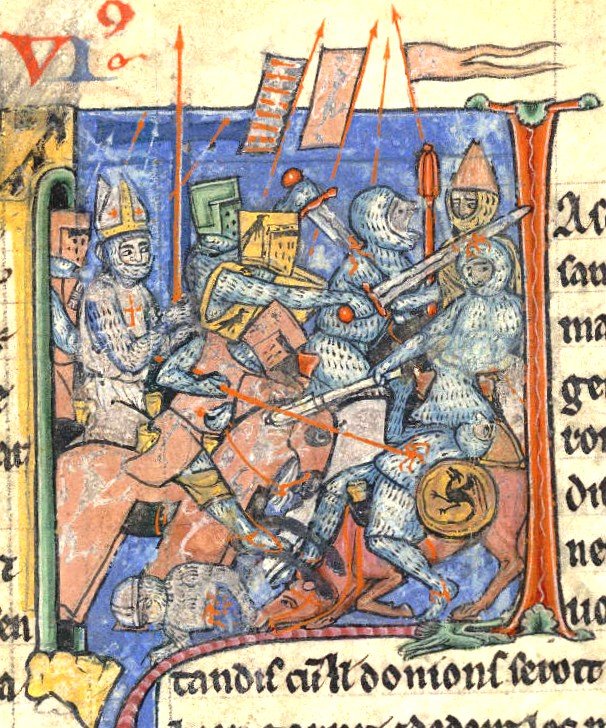
When the First Crusaders reached Antioch in October 1097, all hope seemed lost. Yet, against all odds, they managed a decisive victory over their Muslim adversaries. How could such a desperate and exhausted army experience such a sudden turn of fortune? This account explores the discovery of a hidden relic, the Holy Lance of Antioch, whose presence reportedly inspired the Crusaders to achieve triumph when all seemed lost.
The Siege of Antioch (October 1097 – June 1098)
The Crusaders departed Europe in August 1096 and travelled through some of the most hostile terrain imaginable. They arrived at Antioch on 20 October 1097 and confronted a city that was heavily fortified. The siege that followed lasted nine gruelling months. Both the Crusaders and the city’s inhabitants suffered greatly. Starvation claimed one in five Crusaders, who resorted to eating horses, dogs, and even seeds found in manure.
In June 1098, Bohemond of Taranto, later to become the city’s ruler, persuaded an insider to betray Antioch. A small contingent of Crusaders climbed the walls, opened a gate, and allowed the army to enter. Once inside, the Crusaders took revenge on the city’s Muslim population after enduring such prolonged hardship. As the chronicler of the Gesta Francorum notes:
“All the squares of the city were already everywhere full of the corpses of the dead, so that no one could endure it there for the excessive stench. No one could go along a street of the city except over the bodies of the dead.”¹
From Besiegers to the Besieged
Even after capturing most of Antioch, the Crusaders could not secure the citadel, from which attacks continued against them. Soon, Kerbogha, regent of Mosul, arrived with a large army, surrounding the Crusaders and attempting to starve them into submission:
“…the crowds of non-combatants and ordinary people were forced to devour their leather shoes because of the pressure of hunger. Some, indeed, filled their wretched bellies with roots of stinging nettles and other sorts of woodland plants…”²
The Crusaders, trapped and starving, could only wait for a miracle.
Peter Bartholomew and the Vision of the Holy Lance
That miracle appeared in the form of Peter Bartholomew, a humble monk in the contingent of Raymond of St. Giles. Peter claimed to have received a series of visions over several months, which intensified after entering Antioch. According to Raymond d’Aguilers, chaplain to Raymond of St. Giles, Peter was visited in dreams by St. Andrew and Christ, who revealed the location of the Holy Lance. This spear had pierced Christ’s side during the Crucifixion.
Peter was instructed to inform Raymond of St. Giles and gather twelve men to dig in St. Peter’s Church, where the relic lay buried. The vision promised: “Whoever shall bear this lance in battle shall never be overcome by an enemy.”³
The Discovery of the Holy Lance (15 June 1098)
Following the vision, Raymond ordered a digging party at the indicated location. After a day of fruitless searching, Peter eventually uncovered the lance. The chronicler recorded:
“And I, who have written this, kissed it when the point alone had as yet appeared above ground.”⁴
While Raymond of St. Giles and his chaplain believed in the lance’s authenticity, some leaders, including Bohemond of Taranto and Adhemar of Le Puy, remained sceptical. Adhemar may have doubted the relic due to Peter’s low status, and because a Holy Lance was already known to exist in Constantinople.⁵ Nevertheless, the discovery greatly boosted Crusader morale. In a letter to Pope Urban II, leaders wrote that the relic had comforted and emboldened them:
“We were so comforted and strengthened by [the Lance’s] discovery and by so many other divine revelations that some of us who had been discouraged and fearful beforehand then became courageous and resolute to fight, and encouraged each other.”⁶
The Defeat of Kerbogha (28 June 1098)
Armed with the Holy Lance, the Crusaders confronted Kerbogha’s forces outside Antioch. Despite being heavily outnumbered, their confidence in the relic’s power and reports of celestial armies aiding them spurred a decisive victory. The Crusaders routed Kerbogha’s forces, and the survivors fled in disarray.
Accounts even describe supernatural apparitions, including St. George leading a divine cavalry, reinforcing the perception that God favoured the Crusaders at this crucial moment.⁷
Controversy and Aftermath
Not all accepted the lance as genuine. Peter underwent a trial by fire on 8 April 1099 to prove the authenticity of his visions, emerging unscathed by the flames but suffering injuries from the crowd.⁸ He later fell gravely ill and died, leaving lingering doubts about both his claims and the relic.
The debate over the Holy Lance caused significant divisions among the Crusade’s leaders. Raymond of St. Giles remained its staunchest supporter, while clerics like Arnulf of Choques questioned its legitimacy.⁹ Despite this, the story of the Holy Lance became a key part of First Crusade narratives and shaped the expedition’s historical memory.¹⁰
Footnotes
- ‘The Fall of Antioch: The Gesta Version’, in E. Peters (ed.), The First Crusade: The Chronicle of Fulcher of Chartres and Other Source Materials, (1998), p. 205.
- S.B. Edgington (ed. and trans.), Albert of Aachen’s History of the Journey to Jerusalem, (2013), p. 158.
- ‘The Discover of the Holy Lance: The Version of Raymond d’Aguilers’, in E. Peters (ed.) The First Crusade: The Chronicle of Fulcher of Chartres and Other Source Materials, (1998), p. 215.
- ‘The Discovery of the Holy Lance: The Version of Raymond d’Aguilers’, in E. Peters (ed.) The First Crusade: The Chronicle of Fulcher of Chartres and Other Source Materials, (1998), p. 220.
- T. Asbridge, ‘The Holy Lance of Antioch: Power, Devotion and Memory on the First Crusade’, Reading Medieval Studies vol. 33, (2007), pp. 5-6.
- ‘The Discover of the Holy Lance: The Version of Raymond d’Aguilers’, in E. Peters (ed.), The First Crusade: The Chronicle of Fulcher of Chartres and Other Source Materials, (1998), p. 219.
- T. Asbridge, ‘The Holy Lance of Antioch: Power, Devotion and Memory on the First Crusade’, Reading Medieval Studies vol. 33, (2007), p. 10.
- C. Sweetenham, (ed. and trans.) The Chanson D’Antioche: An Old-French Account of the First Crusade, (2011), pp. 285-286.
- ‘The Defeat of Kerbogha: The Gesta Version’, in E. Peters (ed.), The First Crusade: The Chronicle of Fulcher of Chartres and Other Source Materials, (1998), p. 223.
- J. Hugh Hill and L.L. Hill (trans.) Raymond d’Aguilers, Historia Francorum qui ceperunt Iherusalem (1968), p. 108.